Search all Namibia Accommodation


Popular places in NamibiaNamib Desert Area Etosha National Park Fish River Canyon Accommodation GuidePlaces to stay around Namibia South Namibia Central Namibia Northern Namibia Coastal Namibia |

Namibia Essential
|
Travel Guide to
|


Windhoek - Namibia
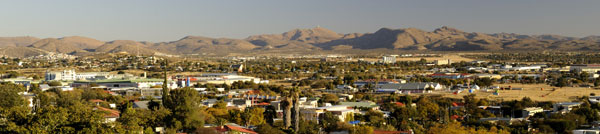
Windhoek is the capital and largest city of the Republic of Namibia.
It is located in central Namibia in the Khomas Highland plateau area around
1,700 metres (5,600 ft) above sea level. The 2001 census determined Windhoek's
population was 233,529. A population influx from all over Namibia has
caused researchers to estimate the figure to be well over 300,000.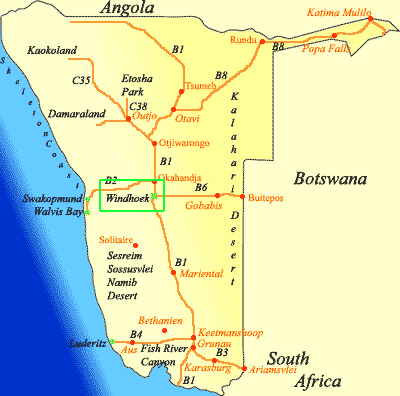
Due to its relative size Windhoek is even more so the social, economic,
and cultural centre of the country than other capitals.
Virtually every national enterprise has its headquarters here. The University
of Namibia is here, as is the country's only theatre, all ministry head
offices, and all major media and finance bodies.
A blend of innovative modern design and old German colonialism, Windhoek is Namibia's capital city and lies in the heart of the central highlands in an airy basin surrounded by rolling mountains.
It's a laid-back, funky and eclectic place: as capital cities go, this is one of the safest and most relaxed in Southern Africa and a perfect place to start or finish a Namibian holiday. It's a logical stopover for those heading north to the Etosha National Park or east to the Namib-Naukluft Park and the towering dunes at Sossusvlei. A good road runs from Windhoek to the resort town of Swakopmund with its enticing array of adventure activities.
For a country with such a small population there has been a surprisingly complex and intertwined history. In Windhoek you will see people from the fairest blond to the darkest black and everybody in between. Many of the women are quite stunning with an amazing assortment of intricate hair styles from long fine plaits to a weave of curly twirly ringlets - and it's not unusual to see out-of-towners in traditional dress.
In the centre of town is a pedestrian precinct with bustling shops and market stalls, whose wares are displayed on the ground. The strong 'cafe culture' of the town makes for great 'people watching' and there is such diversity that you can sit there all day.
It gets quite hot between December to February, but because of its high altitude, humidity is low and nights are pleasantly cooled by a light breeze.
The summer rains can be heavy but the evaporation rate is extremely high so it does not stay damp for long.
Winters can get very cold at night with some frost in low lying areas,
but the days are warm, sunny and cloudless.
History of Windhoek
Pre-colonial
Around 1840, Jonker Afrikaner established a settlement at Windhoek. He
and his followers stayed near one of the main hot springs, located in
the present-day Klein Windhoek suburb. He built a stone church that held
500 people, which was also used as a school. Two Rhenish missionaries,
Carl Hugo Hahn and Heinrich Kleinschmidt, started working there in the
1840s and were later succeeded by two Wesleyans, Richard Haddy and Joseph
Tindall. Gardens were laid out and for a while Windhoek prospered, but
wars between the Nama and Herero eventually destroyed the settlement.
After a long absence, Hahn visited Windhoek again in 1873 and was dismayed
to see that nothing remained of the town's former prosperity. In June
1885, a Swiss botanist found only jackals and starving guinea fowl amongst
neglected fruit trees.
In 1878, Britain annexed Walvis Bay and incorporated it into the Cape of Good Hope in 1884, but Britain did not extend its influence into the hinterland. A request by merchants from Lüderitzbucht resulted in the declaration of a German protectorate over German West Africa in 1884. The German colony came into being with the determination of its borders in 1890 and Germany sent a protective corps, called the Schutztruppe under Major Curt von François, to maintain order. Von François stationed his garrison at Windhoek, which was strategically situated as a buffer between the Nama and Herero, while the twelve strong springs provided water for the cultivation of food.
Present-day Windhoek was founded on 18 October 1890, when Von François fixed the foundation stone of the fort, which is now known as the Alte Feste (Old Fortress). After 1907, development accelerated as people migrated from the countryside to the city. There was also a larger influx of European settlers arriving from Germany and South Africa. Businesses were erected on Kaiser Street, present Independence Avenue, and along the dominant mountain ridge over the city. At this time, Windhoeks three castles, Heinitzburg, Sanderburg, and Schwerinsburg were built.
Independence Avenue, the main street in downtown Windhoek Foreign administration
after World War I
The German colonial era came to an end during World War I when South African
troops occupied Windhoek in May 1915 on behalf of the British Empire.
For the next five years, a military government administered South West
Africa. Development of the city of Windhoek and the nation later to be
known as Namibia came to a virtual standstill. After World War II, Windhoek's
development gradually gained momentum, as more capital became available
to improve the area's economic climate. After 1955, large public projects
were undertaken, such as the building of new schools and hospitals, tarring
of the city's roads (a project begun in 1928 with Kaiser Street), and
the building of dams and pipelines to finally stabilize the water supply.
It also introduced the World's first potable re-use plant in 1958, treating
recycled sewage and sending it directly into the town's water supply.
Since Namibian independence
With Namibia's independence from South African administration in 1990,
Windhoek was recognised as the capital city of South-West Africa as administered
by the South African government. It continues to be the capital city of
the Republic of Namibia, as well as the provincial capital of the central
Khomas Region. Since then the city experienced accelerated growth and
development.
Geography
The city is the major commercial and financial center of Namibia. It sits
on a sloping plain on the northern side of the Khomas Hochland (Khomas
Highlands) at an altitude of 1,728 metres (5,669 ft).
Expanding the town area has – apart from financial restrictions
– proven to be challenging due to its geographical location. In
southern, eastern and western direction Windhoek is surrounded by rocky,
mountainous areas which make land development costly. The southern side
is not suitable for industrial development because of the presence of
underground aquifers. This leaves the vast Brakwater area north of town
the only feasible place for Windhoek's expansion