
madbookings.com
Real people · No booking fees · 30+ years in Southern Africa

Namibia guide, start here · ask us questions

First Time Visiting Namibia?
Everything You Need to Know
(2027 Guide)

Planning your first trip to Namibia can feel overwhelming, but it doesn't have to be. We've answered the questions every first-time visitor asks, with expert advice to help you travel with confidence and make the most of your adventure.

Written by
Real people — Simon & Jen and the Madbookings team
Experience
30+ years driving and booking these roads
Cost
Free to read · no sign-up, no booking fees
Next step
Send us an outline and we'll build the trip for you

The big questions

Six answers · the ones we are asked every week
Safety

Is Namibia safe?

Short answer: Yes. Namibia is one of Africa's safest and most rewarding travel destinations, especially for visitors exploring on a self-drive holiday.

The country is politically stable, has a well-developed tourism industry, and welcomes thousands of international travellers every year. Like anywhere in the world, sensible precautions are important. Most visitors experience no problems, but it's wise to keep valuables out of sight, avoid walking alone at night in unfamiliar urban areas, and never leave luggage unattended in your vehicle.

Malaria in Namibia transmitted by mosquitoes that bite between dusk and dawn. It is a serious illness — but for travellers to Namibia specifically, it's a seasonal (December to April) and geographically limited one. The country's dry southern desert is malaria-free; the risk is in the wetter northern strip.  Avoid getting bitten — dusk to dawn is the danger window; long sleeves, repellent and mosquito nets.

The greatest risk for most travellers isn't crime — it's driving. Namibia's vast distances and gravel roads require concentration, so plan realistic daily driving distances, reduce your speed on gravel roads, avoid driving after dark, and take regular breaks.

Wildlife is another reason to exercise common sense. Always keep a safe distance from animals, follow park rules, and never leave your vehicle unless you're in a designated area.

With good planning and a few simple precautions, Namibia is a very safe country to explore. Its friendly people, spectacular landscapes and peaceful atmosphere are among the reasons so many visitors return again and again.

Top tips

  • Avoid driving after dark
  • Slow down on gravel roads
  • Carry plenty of drinking water
  • Fill up whenever you can in remote areas
  • Keep valuables out of sight
  • Stay inside your vehicle in national parks
Read the full health & safety guide
Vehicles

Do I need a 4x4?

Short answer: Need No - Recommended yes — we do recommend a 4x4 to travel around Namibia.

You do not need a 4x4. You can get from Windhoek to Swakopmund, Sesriem, Fish River Canyon, Etosha, even most of Damaraland in a 2WD sedan. Indeed I have driven a Ford Focus to all these places — though I did get stuck in Damaraland, and I was travelling alone, in the June to September dry season.

Why we recommend a 4x4

  1. Suited to the gravel. Most roads in Namibia are gravel of varying quality, with sandy patches, corrugations, dips and rocks. A bigger 4x4 has better grip, bigger tyres and offers a lot more comfort.
  2. Space inside. With four people plus luggage there is not much room left in a 2WD sedan.
  3. Camping gear. Cooking and camping equipment takes up a lot of space, and few companies offer sedan rentals with it. Rooftop tent vehicles are all 4x4 rentals. Some campsites have sandy or rocky access roads — Sesriem and Damaraland in particular.
  4. Better visibility. A higher viewing point makes game spotting easier.
  5. Sand, rain and bumps. A sedan can struggle with all of these.
  6. Comfort. In a 2WD sedan you feel the long bumpy journeys more, which detracts from the enjoyment.

The downside of a 4x4

  1. More expensive to rent
  2. Higher fuel consumption
  3. Bigger to drive — not that you'll meet much traffic outside Windhoek
  4. Fully equipped camping vehicles book out a long way ahead for travel between May and September
Read the full car hire guide
Trip length

How many days do I need?

Short answer: Fourteen days is the ideal first trip to Namibia — enough time for the landscapes, the wildlife and the road trip itself without feeling rushed.

If you have less time, don't worry — it can still be incredibly rewarding. Just make sure you have a well-planned itinerary.

  • 7 days — Perfect for a taste of Namibia. Keep it to just a few places, visiting highlights such as Sossusvlei, Swakopmund and Etosha National Park.
  • 10 days — The most popular choice, allowing you to enjoy Namibia's main attractions at a comfortable pace. Still limit the number of places and enjoy each one more.
  • 14 days — Our recommended itinerary for first-time visitors, combining the famous sights with time to relax and enjoy the journey.
  • 18–21 days — Ideal if you want to explore remote regions such as Damaraland, the Skeleton Coast, the Zambezi Region or the Fish River Canyon without long driving days.

One mistake many first-time visitors make is trying to see too much in too short a time. Namibia is nearly four times the size of the United Kingdom, and while its roads are generally excellent, the distances between destinations are long — and hot.

Read the full self-drive planning guide
Timing

When should I visit Namibia?

Short answer: June to September.

Namibia is a fantastic destination all year round, but the best time to visit depends on what you want to experience. Whether you're hoping to see incredible wildlife, photograph dramatic landscapes or simply enjoy warm, sunny weather, every season has something special to offer.

June to September — the dry season

These cooler, dry winter months offer pleasant daytime temperatures, clear skies and some of the best wildlife viewing in Africa. As water becomes scarce, animals gather around waterholes, making game viewing in places like Etosha National Park particularly rewarding. If your main interest is photography, the dry season also brings crisp air, beautiful golden light and spectacular star-filled night skies.

November to April — the green season

The summer months are warmer and can bring afternoon thunderstorms, transforming the landscapes with lush green vegetation and attracting thousands of migratory birds. It's also an excellent time for birdwatching and dramatic cloud-filled desert photography.

May & October — the missing months

This is when I visit Namibia the most, May is just coming off the hot rainy season and October is coming off the cold winter into the rainy season. This makes it the "possible" best time to visit Namibia BUT it has some risks that make it the most unpredictable time of year to visit: it could rain anywhere, anytime, and the temperatures are all over the place both hot and cold. If you are sticking to the main routes and prepared for all weathers then come and find me.

There is no single “perfect” month to visit Namibia. Instead, choose the season that matches the holiday you want — a wildlife safari - June to Sept, a scenic self-drive adventure - May to October, a photography expedition all year.

Read the full seasons guide
Where to go

Where should I go?

Short answer: Sossusvlei, Etosha, Damaraland.
For your first visit, you don't need to see every corner of Namibia to experience its magic.

The country's classic highlights combine spectacular scenery, unforgettable wildlife and some of Africa's most rewarding road trips. Most first-time visitors should include these destinations:

  • Etosha National Park — Namibia's premier wildlife destination, famous for elephants, lions, rhinos and its floodlit waterholes.
  • Sossusvlei — Home to the world's highest red sand dunes, the ancient camel thorn trees of Deadvlei and unforgettable desert sunrises.
  • Swakopmund — A charming coastal town where adventure meets relaxation, offering everything from quad biking and sandboarding to dolphin cruises.
  • Damaraland — One of Namibia's most spectacular landscapes, known for dramatic mountains, ancient rock engravings and desert-adapted elephants.
  • Windhoek — The perfect place to begin and end your journey, with excellent restaurants, shops and easy access to Namibia's international airport.

If you have more time, consider adding ONE of the following: Skeleton Coast, Fish River Canyon , Kalahari Desert or Aus.  Leave the distant or remote wilderness of Kaokoland, Khaudom and Zambezi Region (Caprivi) for a longer and more experienced trip.

Our recommendation: for a first visit, spend 10 to 14 days on the classic circuit and save the far corners for next time.

Read the full best-places guide
Budget

How much does it cost?

Short answer: Between US$150 and US$400+ per person, per day.

These estimates usually include camping or accommodation, vehicle hire, meals, fuel and park entrance fees, but exclude international flights and personal expenses.

Let's be honest — Namibia is not a budget destination, for a number of reasons:

  1. It's remote
  2. It doesn't cater to mass tourism
  3. Accommodation is limited
  4. Transport is restricted to self-drive, and driving distances are long

The key is to get the best value out of your trip, and that is where expertise and knowledge come in handy.

Three ways to self-drive Namibia

1
Camping self-drive
Pros
  • Saves on accommodation costs — and Namibia is the best camping country in the world (in my humble opinion)
  • Stop anywhere for a snack, with a fridge for cold drinks
  • You sit around a fire each night in spectacular scenery
  • At the right places you can still use plenty of lodge facilities
Cons
  • Fully equipped camping vehicles cost a little more to rent
  • You have to buy food and cook every meal — either a great experience or a chore
  • It can be dusty
  • Less space in the car
  • On the coast the wind can make camping uncomfortable
  • Hot in a tent in summer, even at night — and cold in winter

Suggestion: book mostly camping and add a lodge at some places — Windhoek, the coast, or a special treat at a prime location.

2
Accommodated classic self-drive
Pros
  • No setting up camp at each stop
  • Easier, more comfortable, more relaxing
  • Cheaper car rental than camping vehicles
  • More room in the car
  • All the lodge facilities available to you
Cons
  • Cost is the obvious one — rooms are more expensive than camping
  • Mid-range accommodation is usually bed and breakfast, so you still organise and pay for other meals
  • No fridge for food and drinks, and no self-catering equipment

Tip: most accommodation in Namibia is not near a town, so you are restricted to eating where you stay — or going hungry, which we don't recommend. This is especially true inside the national parks.

3
Luxury self-drive
Pros
  • You will be in the best locations
  • The nicest accommodation
  • Unique experiences exclusive to some lodges
  • A more personal service
Cons
  • Cost — you get what you pay for. Luxury in Namibia isn't as expensive as some parts of the world, so the value is exceptional, but that doesn't make it cheap.

Tip: whether you're camping or in classic accommodation, a one or two night splurge at a special lodge can usually be squeezed into the budget — and gives you a once-in-a-lifetime experience.

Getting the best value

Travelling during Namibia's quieter season, November to April (excluding December at the coast), can often reduce accommodation costs. Booking well in advance is recommended if you're visiting between June and October, when many of the country's most popular lodges and national parks fill up quickly.

Our recommendation: a comfortable mid-range self-drive holiday offers the best value for most first-time visitors, combining excellent accommodation, reliable transport and the freedom to explore Namibia at your own pace.

If you're unsure what your trip might cost, we're happy to prepare a personalised itinerary and quotation based on your travel dates, interests and budget — free of charge.

Read the full money & costs guide

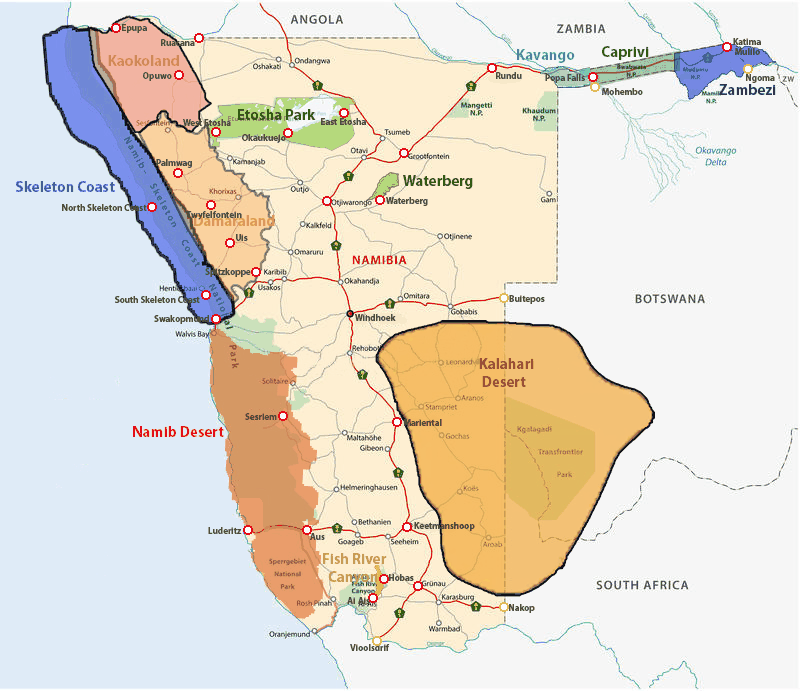
Ready to explore Namibia? Tap the map

13 areas · add the ones you like to your route

Every area below is somewhere first-time visitors ask us about. Tap one to see what it’s like and what there is to do — and add the ones you fancy to your route as you go. When you’re done we’ll plot it and work out a day-by-day itinerary.

Map of Namibia showing the main areas to visit Kalahari Namib & Sossusvlei Skeleton Coast Swakopmund Etosha Damaraland Waterberg Lüderitz Kavango & Caprivi Windhoek Fish River Canyon Zambezi Kaokoland Kalahari Namib & Sossusvlei Skeleton Coast Swakopmund Etosha Damaraland Waterberg Lüderitz Kavango & Caprivi Windhoek Fish River Canyon Zambezi Kaokoland

Tap an area to explore it

Thirteen areas, one country

Namibia divides neatly into a handful of very different places — dune sea, wild coast, rock-art desert, big-game park, river country. Tap one on the map to see it, and add the ones you like to your route.

The far north-west

Kaokoland

We haven’t written this one up yet — it’s on the list. You can still add it to your route.

Photos and a full description are coming. In the meantime, tap Damaraland on the map to see how these will look.

The wild coast

Skeleton Coast

We haven’t written this one up yet — it’s on the list. You can still add it to your route.

Photos and a full description are coming. In the meantime, tap Damaraland on the map to see how these will look.

The north-west

Damaraland

Ancient rock art, desert elephant and some of the emptiest, most striking country in Namibia.

2–3 nightsGravel roadsBest Apr–Oct4x4 advised
damaraland-1.webp
damaraland-2.webp
damaraland-3.webp
damaraland-4.webp
damaraland-5.webp
damaraland-6.webp

Twyfelfontein rock engravings

Damaraland is where Namibia stops being a landscape and starts being a place. Burnt-orange hills, dry riverbeds lined with ancient trees, and the rock engravings at Twyfelfontein that people were carving six thousand years ago.

It is also the best place in the country to look for desert-adapted elephant and black rhino — animals that have learned to live where there is almost no water. Palmwag and the concessions to the north are the places to base yourself for that.

Getting there: mostly good gravel, slow going. Allow half a day from Swakopmund and the same again on to Etosha.

The great game park

Etosha

We haven’t written this one up yet — it’s on the list. You can still add it to your route.

Photos and a full description are coming. In the meantime, tap Damaraland on the map to see how these will look.

The central plateau

Waterberg

We haven’t written this one up yet — it’s on the list. You can still add it to your route.

Photos and a full description are coming. In the meantime, tap Damaraland on the map to see how these will look.

The dune sea

Namib & Sossusvlei

We haven’t written this one up yet — it’s on the list. You can still add it to your route.

Photos and a full description are coming. In the meantime, tap Damaraland on the map to see how these will look.

The red desert

Kalahari

We haven’t written this one up yet — it’s on the list. You can still add it to your route.

Photos and a full description are coming. In the meantime, tap Damaraland on the map to see how these will look.

The deep south

Fish River Canyon

We haven’t written this one up yet — it’s on the list. You can still add it to your route.

Photos and a full description are coming. In the meantime, tap Damaraland on the map to see how these will look.

River country

Kavango & Caprivi

We haven’t written this one up yet — it’s on the list. You can still add it to your route.

Photos and a full description are coming. In the meantime, tap Damaraland on the map to see how these will look.

The far east

Zambezi

We haven’t written this one up yet — it’s on the list. You can still add it to your route.

Photos and a full description are coming. In the meantime, tap Damaraland on the map to see how these will look.

The coast town

Swakopmund

We haven’t written this one up yet — it’s on the list. You can still add it to your route.

Photos and a full description are coming. In the meantime, tap Damaraland on the map to see how these will look.

The diamond coast

Lüderitz

We haven’t written this one up yet — it’s on the list. You can still add it to your route.

Photos and a full description are coming. In the meantime, tap Damaraland on the map to see how these will look.

The capital

Windhoek

We haven’t written this one up yet — it’s on the list. You can still add it to your route.

Photos and a full description are coming. In the meantime, tap Damaraland on the map to see how these will look.

Ready for the detail?

Free guides · written first-hand

Those six answers get you started. When you want to go deeper, every one of these is free to read and written by people who have driven the roads.

Ready to plan for real?

Send us your outline — we'll build the trip for free

Reading is the fun bit; arranging is the work. Once you know the shape of the trip you want, tell us — must-see highlights, number of travellers, rough dates — and a real person who's been to every place will build the itinerary and price it for you. No fees on top of anything.

Plan my Namibia    or WhatsApp us directly

No extra fees

You pay each place's own rate — nothing on top.

Best prices

We know where the value hides in every region.

Expert advice

First-hand, from people who drive these roads.

Friendly, fast service

Real people, replies usually the same day.

Go to my route →