Namibia driving guide · 2027 edition · free & printable
Namibia is the easiest country in Africa to self-drive — left-hand side, quiet roads, courteous police — but the rules matter, the roadblocks are real, and the speed limits step down fast at every town. Here's everything the law expects of you behind the wheel, how fines actually work when they happen, and the roadside habits that keep our clients out of trouble. From the people who drive these roads every month.
Start here
Namibia drives on the left, like South Africa, the UK and Australia. Rental cars are right-hand drive, you overtake on the right, and give way to the right at circles (roundabouts). If you're coming from Europe or North America, the first hour out of the airport is when mistakes happen — take it slowly, think at every junction, and you'll have the hang of it by Okahandja.
Namibia also requires all vehicles to have their lights on at all times, day or night.
The rules themselves hold few surprises: seatbelts are compulsory for every occupant, front and back; handheld phone use while driving is illegal; children should be in appropriate child seats (arrange these with your rental company in advance); and your vehicle must carry a red warning triangle — every properly supplied rental does. Insurance follows the law: break a rule that contributed to an incident and you hand your insurer a reason to walk away.
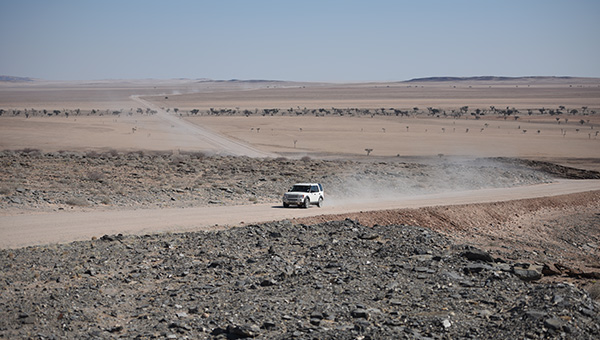
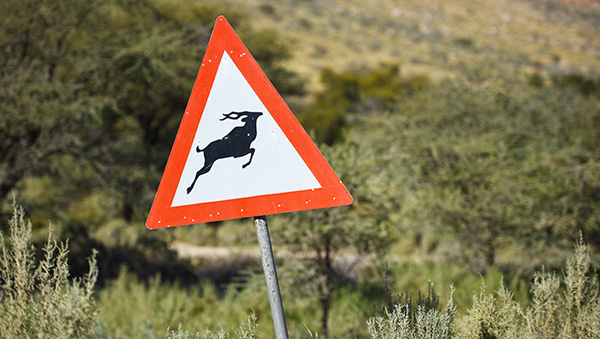
What is different is the environment the rules live in. Distances are huge, most scenic roads are gravel, fuel stations are far apart, and the roads outside towns are unfenced — kudu, warthog, cattle, donkeys and goats treat them as part of the farm. That's why the advice in this guide is sometimes stricter than the law: the law allows 100 km/h on gravel and driving at midnight; three decades of experience says 80 and be parked by sunset.
This guide covers the rules and what happens when you break them. For the full how-to-drive-here handbook — road types, corrugations, tyre strategy, distances — read our self-drive planning guide, and for choosing and insuring the vehicle itself, our car hire guide.
The numbers that matter
Unless a sign says otherwise, these are the national defaults. The pattern to burn into memory is the town-entry step-down: 120 → 80 → 60 in quick succession, and that 80 zone is where the cameras and radar sit.
| Road type | Legal limit | Our honest advice |
|---|---|---|
| Towns & built-up areas | 60 km/h | Watch for signed 40 zones near schools; pedestrians and taxis stop without warning |
| Town approaches (signed) | 80 km/h | The classic camera zone — brake to the sign, not after it |
| Open tarred roads (B & main C roads) | 120 km/h | 100–110 is calmer, cheaper on fuel and safer around wildlife |
| Gravel roads (C & D roads) | 100 km/h | Drive 80 maximum — most rental contracts require it, and most rollovers happen above it |
| Salt roads (coast, C34) | As signed | Treat like gravel; slippery when the fog wets the surface |
| National parks (Etosha etc.) | 60 km/h | Strictly enforced inside Etosha — and the animals set the real pace anyway |
Signed limits always override the defaults above. Roadworks on the B roads use single-lane stop-go sections with temporary limits — they are enforced, and the wait is never long. Towing? Lower limits apply to vehicles with trailers; your rental company will confirm the figure for your combination.
What to carry
Your full home driving licence is valid in Namibia provided it's printed in English and carries your photo. If it's not in English — or if it's a licence style your home country pairs with a translation — carry an International Driving Permit alongside the original. The IDP is a translation document, not a licence: it only works together with the real thing.
Carry your licence every time you drive; "it's at the lodge" doesn't work at a checkpoint. Keep it with your passport during the day's drive, plus the rental paperwork the company gives you — that folder is your proof the vehicle is legitimately yours to drive, and officers do ask for it.
If you're crossing from South Africa or Botswana in a foreign-registered vehicle (including a SA-registered rental), you'll pay a Cross-Border Charge / road fund levy at the border post — a modest fee, paid once, receipt kept in the vehicle. SA rental cars also need the rental company's cross-border letter of authority. Namibian-registered rentals pay nothing; there are no toll roads anywhere in the country.
Two minutes at vehicle pickup checking the triangle, spares and jack saves an afternoon on the C14. Our car hire guide has the full pickup-day checklist.
You will meet these
Every Namibia road trip meets a few police checkpoints — usually on the main roads near towns, marked well in advance with signs and cones. They are routine, professional and nothing to be nervous about: slow right down, switch off music, remove sunglasses, greet the officer, and have your licence ready. You'll typically be asked where you're heading, your licence will be glanced at, and you'll be waved through in under a minute.
Speed cameras are the enforcement you're more likely to actually meet. Fixed and mobile cameras concentrate on the tarred highways — especially those 80 km/h town-approach zones — and mobile radar operates near larger towns. A camera fine on a rental car follows the number plate to the rental company, which passes it to your credit card with an admin fee on top, sometimes months after you're home. The cheap fix is simply driving the signed limit through every town approach.
On the B1 and other northern routes you'll also cross veterinary control points — the Red Line. These aren't police stops: they control animal-product movement, and heading south you may be asked whether you're carrying raw meat, which can be surrendered or cooked depending on the point. It's quick and courteous if you know the rules — our Red Line guide covers exactly what can cross.
When it happens anyway
Namibian traffic fines follow a written-notice system. If you're stopped for an offence, the officer issues a written fine (a "ticket" or admission-of-guilt notice) stating the offence and the amount. You then pay at a police station or magistrate's court — in person, against an official receipt. Legitimate roadside payment does not exist; anyone suggesting it is inviting you into a bribe, and a polite "I'll pay at the station, may I have the written notice please" ends that conversation quickly.
Amounts scale with the offence. As a rough guide, minor speeding runs to a few hundred Namibia dollars, climbing steeply as the excess grows; serious offences — high-speed excess, reckless driving, drink-driving — move out of fine territory altogether and into arrest and a court appearance. Exact schedules change, so treat any number you read online (including here) as indicative and the written notice as definitive.
Camera fines work differently: they chase the plate, not the driver. The rental company receives them, pays or forwards them, and bills your card with an administration fee added — often after your trip has ended. There's no negotiating that admin fee, which is one more argument for driving town approaches at the sign.
Genuinely believe a fine is wrong? Don't fight it at the cones. Note the officer's name and the checkpoint location, photograph the notice, and dispute it at the police station named on the ticket — or ask us; we've helped clients navigate this more than once.
Zero-ambiguity rules
The legal blood-alcohol limit is 0.05g per 100ml — for many people that's roughly one drink, and roadblock breath-testing does happen, especially around towns at weekends and holidays. Cross the line and you're not looking at a fine but at arrest, a night in cells and a court date, plus a rental-insurance contract that has just become waste paper. Namibia's lodge culture solves this elegantly: sundowners happen after the day's drive ends, at the place you're sleeping. Our advice is simply zero if you're driving that day.
Handheld phone use is illegal while driving. Use a cradle for navigation or hand the phone to your passenger — and honestly, on these roads the better habit is loading the route before you set off; signal disappears for hours anyway, so offline maps do the real work.
Seatbelts are required for every occupant, every seat, all the time — and on gravel this is the rule with the most physics behind it. A corrugation slide at 80 km/h is survivable belted and often isn't otherwise. Kids need proper child seats; book them with the vehicle so they're fitted at pickup.

Where the law ends and judgement begins
Nothing in Namibian law stops you doing 100 km/h on gravel at 10pm. Physics and wildlife will, and the outcome is the single most common serious incident involving visitors. So treat these two as rules, because your insurance company quietly does:
Gravel at 80, always. Above 80 km/h on gravel, stopping distances stretch, corrugations float the tyres, and one over-correction becomes a rollover. Most rental contracts cap gravel speed at 80 in writing — exceed it and you may be paying for the vehicle, not the excess. Brake before corners, never in them; slow right down and keep left for oncoming dust plumes; and never brake hard in thick sand.
Parked by sunset, outside towns. Kudu are the killer — a heavy antelope that jumps at headlights, at windscreen height, at dusk. Add unfenced cattle, donkeys on warm tar, and zero street lighting, and night driving becomes the one risk we tell every client to simply refuse. Many rental contracts restrict or void portions of cover for night-time animal collisions on open roads. Plan each day to arrive with the sun still up — the sundowner is better than the alternative in every way.
The full gravel technique — tyre pressures, dust discipline, corrugation rhythm, sand — is in our self-drive planning guide.
If the worst happens
Even a minor scrape has a required sequence in Namibia, and skipping it can cost you the insurance claim. Stop immediately — leaving an accident scene is an offence. Check everyone, move to safety, triangle out behind the vehicle. Then work the list on the right.
The step visitors miss is the police report: any accident involving another party, an animal or meaningful damage must be reported to the police — as a firm rule, in person and within 24 hours — and you need the case/reference number they issue. No case number, and most insurance and rental-damage claims stall on arrival. Even for a solo mishap on an empty road (a rollover, a kudu at dusk), report it; your rental company will insist.
Hit livestock? Same rules — stop, photograph, report. Farm animals on the road are a shared reality here, and the police process is routine. Hit nothing but a pothole and lost two tyres? Not an accident, but call the rental company before arranging repairs so the costs stay claimable.
No signal? Flag the next vehicle — Namibians stop for each other as a matter of course — or ask at the nearest farm gate, fuel station or lodge; they'll know exactly whom to call.
Quick answers
Yes — a full licence in English with a photo is accepted. Not in English? Carry an International Driving Permit alongside the original. Either way, the licence rides with you every drive.
Yes — fixed and mobile, concentrated on tarred highways and the 80 km/h town-approach zones. Camera fines follow the rental plate to the rental company, and land on your card with an admin fee added.
Against the written notice, at a police station or magistrate's court, with an official receipt. Never cash at the roadside. Keep the receipt with your rental papers until the trip is long over.
No — just genuinely dangerous, and often restricted by your rental contract's cover terms. Wildlife and livestock own the unlit roads after dark. Plan to be parked by sunset outside towns; it's the one piece of advice we'd make law if we could.
0.05g per 100ml of blood — about one drink for many people, tested at roadblocks, with arrest and court beyond it. Simplest policy on a driving day: zero, and enjoy the sundowner where you sleep.
Veterinary Red Line control points — animal-product control, not police stops. Southbound, raw meat is the issue. Our Red Line guide explains the fence, the checkpoints and exactly what food can cross.
Always — legally when herded, practically in every case. Slow to walking pace for livestock on the road, hoot gently if they hold their ground, and remember the herd you see hides the calf you don't.
Rules read — roads next
Every itinerary we plan is paced for daylight arrivals, realistic gravel speeds and full fuel stops — the rules in this guide, baked into the route so you never have to choose between the schedule and the sensible thing. Tell us your dates and must-sees, and a real person who drives these roads will plan and price it free.
You pay each place's own rate — nothing on top.
We know where the value hides in every region.
First-hand, from people who drive these roads.
Real people, replies usually the same day.