madbookings

Namibia activity guide · 2027 edition · free & printable

Birding Namibia — 700 species, four worlds

Namibia shouldn't be this good for birds. A country this dry has no right to flamingo lagoons forty thousand strong, riverbanks drilled pink with carmine bee-eaters, a lark that lives nowhere on earth but one dune sea — and around 700 recorded species in total. The secret is contrast: coast, desert, escarpment and wetland, each with its own cast, all reachable in one road trip. Here's where the birds are, when to come, the specials you can't see anywhere else, and how to bird this country properly — whether you're a lifelister or just discovered that the thing on the camel thorn is a pygmy falcon.

The numbers
±700 species recorded · one true endemic, a dozen near-endemics
Top hotspots
Walvis Bay lagoon · Zambezi wetlands · Etosha · Erongo escarpment
Peak season
November–April · migrants in, breeding plumage on
The spectacle
Carmine bee-eater colonies, Aug–Nov on the Zambezi banks

The desert that shouldn't have birds

Why bird Namibia

The pitch is simple: four completely different birding worlds in one easy, self-drivable country. The cold Benguela coast concentrates seabirds and waders into Ramsar-listed lagoons by the tens of thousands. The Namib's gravel plains and dunes hold desert specialists found almost nowhere else. The central escarpment — Erongo, Waterberg, the Windhoek highlands — is the global stronghold of a famous cluster of near-endemics. And in the far north-east, the Zambezi Region's rivers and floodplains deliver a full wetland avifauna of 400-plus species that feels like a different continent.

What makes it exceptional for travelling birders is how gettable it all is. The roads are good, distances honest, the light phenomenal, and the birds — in this open country — are visible in a way forest birding never allows. Beginners fall for the charismatic easy wins: lilac-breasted rollers on every second fence post, crimson-breasted shrikes flashing through the thorn, sociable weaver nests the size of haystacks with pygmy falcons in the penthouse. Lifelisters come for the endemics and leave with most of them. And everyone stops the car for the flamingos.

Best of all, birding here piggybacks perfectly on a normal Namibia circuit — every stop on the classic route happens to be a hotspot. This guide shows you how to bird the trip you were taking anyway, and how to bend it if the birds are the point.
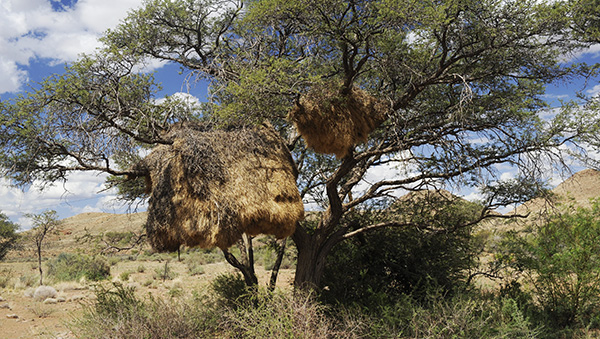
A giant sociable weaver nest on a camel thorn tree in Namibia
Sociable weaver nests — avian apartment blocks, often with a pygmy falcon in residence
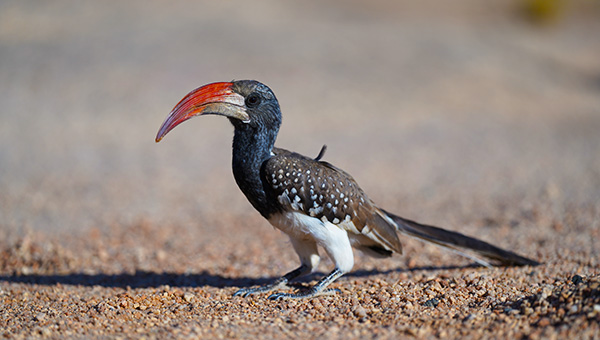
ARed Billed Hornbill Namibia
Red Billed Hornbill often spotted hopping around camp sites

The birds you came for

The specials — Namibia's endemics & near-endemics

Namibia has exactly one true endemic, and it's a beauty of specialisation: the Dune Lark, a soft-toned lark that lives its entire life in the Namib dune sea and nowhere else on earth. The classic stakeout is the Rooibank area near Walvis Bay, on vegetated dune hummocks at dawn — a rite of passage every visiting lister makes.

Around it orbits the famous Namibian near-endemic cluster — species shared only with adjacent south-western Angola, which for most birders makes Namibia the only realistic place to see them. The heartland is the central escarpment: the Erongo mountains, Spitzkoppe, Waterberg and the rocky country around Windhoek. Here live the Rockrunner (a scuttling, wren-like oddity with a glorious dawn song), the maddening Herero Chat, Hartlaub's Spurfowl (a boulder-top dawn caller that humbles everyone), Monteiro's Hornbill, Rüppell's Parrot, White-tailed Shrike (the "mini butcher-bird" that behaves like nothing else), Carp's Tit, Bare-cheeked Babbler and Violet Wood-hoopoe. The Namib's gravel plains add Gray's Lark and Rüppell's Korhaan; the coast contributes the breeding-endemic Damara Tern; and the remote Kunene valley guards the exquisite Cinderella Waxbill for those who venture far north.

A realistic first-trip haul: with the escarpment, coast and Etosha on your route, most of this list is genuinely achievable in two weeks — Herero Chat, Hartlaub's Spurfowl and the Kunene specials being the honest wildcards. A local guide morning at Erongo shortens the odds dramatically.

The target list, at a glance

  • Dune Lark — the only true endemic; Rooibank dunes at dawn
  • Rockrunner — rocky escarpment slopes; sings at first light
  • Hartlaub's Spurfowl — Erongo boulder-tops, dawn only
  • Herero Chat — escarpment thornveld; the famous heartbreaker
  • Monteiro's Hornbill — dry woodland & rocky hills
  • Rüppell's Parrot — riverine trees, Erongo to Kunene
  • White-tailed Shrike — thornveld; unmistakable once seen
  • Bare-cheeked Babbler & Carp's Tit — mopane north
  • Gray's Lark & Rüppell's Korhaan — Namib gravel plains
  • Damara Tern — breeding endemic of the coast
  • Cinderella Waxbill — Kunene valley, for the dedicated

Where the birds are

The great birding hotspots

Every stop on the classic Namibia circuit is a birding site in disguise. Here's the honest ranking of where your binoculars will work hardest.

Namibia's birding hotspots at a glance
HotspotWhat makes it special
Walvis Bay lagoon & Sandwich HarbourRamsar wetlands of global importance — greater and lesser flamingos in their tens of thousands, vast wader flocks, pelicans, Chestnut-banded Plover and the breeding-endemic Damara Tern
Zambezi Region (Caprivi)400+ species — Namibia's richest birding by far; Mahango (Bwabwata) is the standout single site; Slaty Egret, African Skimmer, Rock Pratincole, Pel's Fishing Owl, carmine bee-eater colonies
Etosha National ParkOpen-country birding at its easiest: Kori Bustards, raptors galore, larks and coursers, crimson-breasted shrikes — and flamingos breeding on the pans after exceptional rains
Erongo mountains & SpitzkoppeThe near-endemic heartland — Hartlaub's Spurfowl, Rockrunner, Rüppell's Parrot, Monteiro's Hornbill, White-tailed Shrike among granite boulders
Waterberg PlateauEscarpment specials plus one of Namibia's few Cape Vulture colonies, in walkable, bird-rich green bushveld
Windhoek highlands (Avis Dam, Daan Viljoen)Rockrunner and Monteiro's Hornbill within minutes of the capital — the perfect first and last birding mornings of a trip
Namib gravel plains & RooibankDune Lark's only home, plus Gray's Lark, Rüppell's Korhaan and Tractrac Chat in the moonscape
Kalahari & the southSociable weaver colonies with attendant Pygmy Falcons, sandgrouse at waterholes, and raptor-rich red-dune country
Kunene / Epupa (for the dedicated)Cinderella Waxbill, Rufous-tailed Palm Thrush and Angola-border specials in wild, remote river country

Destination logistics for most of these live in our guides library — Etosha, Spitzkoppe, Waterberg, Sandwich Harbour and more. Tell us birds matter and we'll route the whole trip through them.

Deep dive one

The coast — flamingos by the lagoon-full

The Benguela Current is cold, rich and generous, and the Walvis Bay lagoon is where it pays out. This Ramsar-listed wetland is one of the most important coastal bird sites in Africa: greater and lesser flamingos massed in their tens of thousands, turning whole reaches of the lagoon pink; enormous flocks of migrant waders refuelling on the mudflats between Arctic summers; great white pelicans cruising the channels; and, on the salt-works and sandbanks, the dainty Chestnut-banded Plover and Namibia's breeding-endemic Damara Tern.

The birding is absurdly easy — the lagoon esplanade lets you scan world-class flocks from a parked car with a coffee — and it scales with ambition: a Sandwich Harbour 4x4 excursion adds the wilder southern wetlands where the dunes meet the sea, and the salt pans south of town concentrate waders at high tide. Swakopmund adds its own coastal cast, and pelagic possibilities exist for the truly committed.

Two timing notes: wader numbers peak with the Palaearctic migrants (roughly September–April), while the flamingo spectacle is reliably superb most of the year. And bring the scope if you own one — this is the site in Namibia that rewards it most.

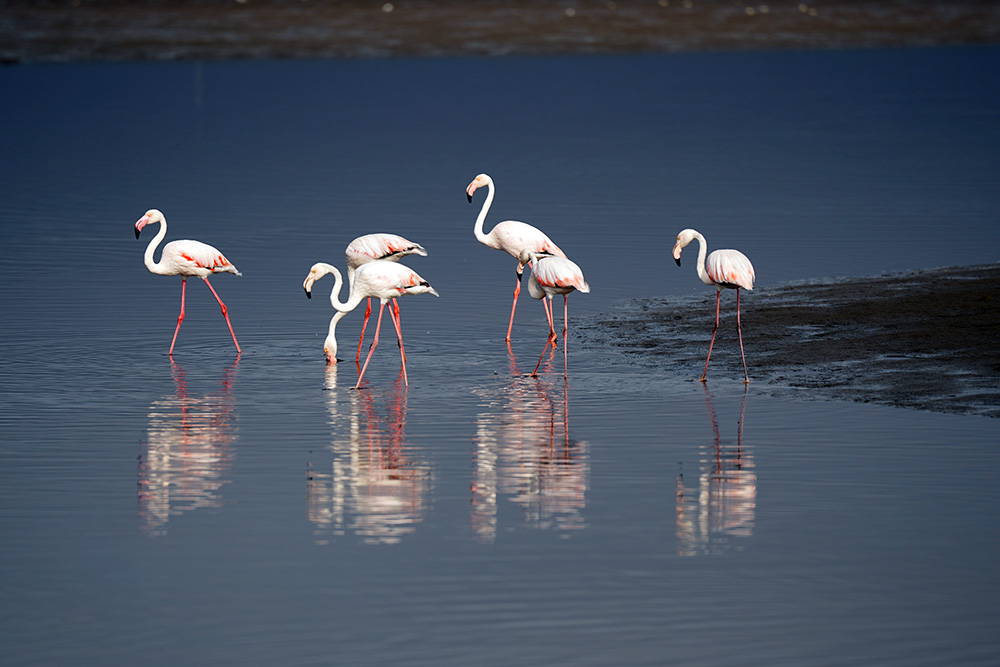
Thousands of flamingos feeding on the Walvis Bay lagoon
Walvis Bay lagoon — a Ramsar site where flamingos mass in the tens of thousands

Deep dive two

The Zambezi — Namibia's 400-species corner

Drive far enough north-east and Namibia stops being a desert. In the Zambezi Region (the old Caprivi), four great rivers thread through riverine forest, papyrus and floodplain, and the bird list explodes past 400 species — comfortably the richest birding in the country and among the best in southern Africa. The crown jewel is Mahango, the core area of Bwabwata National Park: a compact, self-drivable reserve on the Okavango where forest, floodplain and river stack up specials — Slaty Egret, African Skimmer, Rock Pratincole, Wattled Crane, Western Banded Snake Eagle — at a density that keeps the car at walking pace.

Then there's the spectacle nobody forgets: from roughly August to November, thousands of southern carmine bee-eaters colonise the Zambezi's sandbanks, drilling the cutbanks into pink-and-turquoise apartment blocks. Boat-based birding is the region's superpower — a slow drift past skimmer sandbars and fish eagle duels at golden hour, with a real chance of the holy grail, Pel's Fishing Owl, ghosting through the riverine giants at dusk. Mudumu and Nkasa Rupara add wilder floodplain birding for those going deeper.

The Zambezi is a long way from Windhoek — it suits longer itineraries or the classic finish toward Victoria Falls. If birds are the trip's engine, it's worth every kilometre; our team builds Zambezi legs regularly and knows which lodges put the best boats and guides on the water.

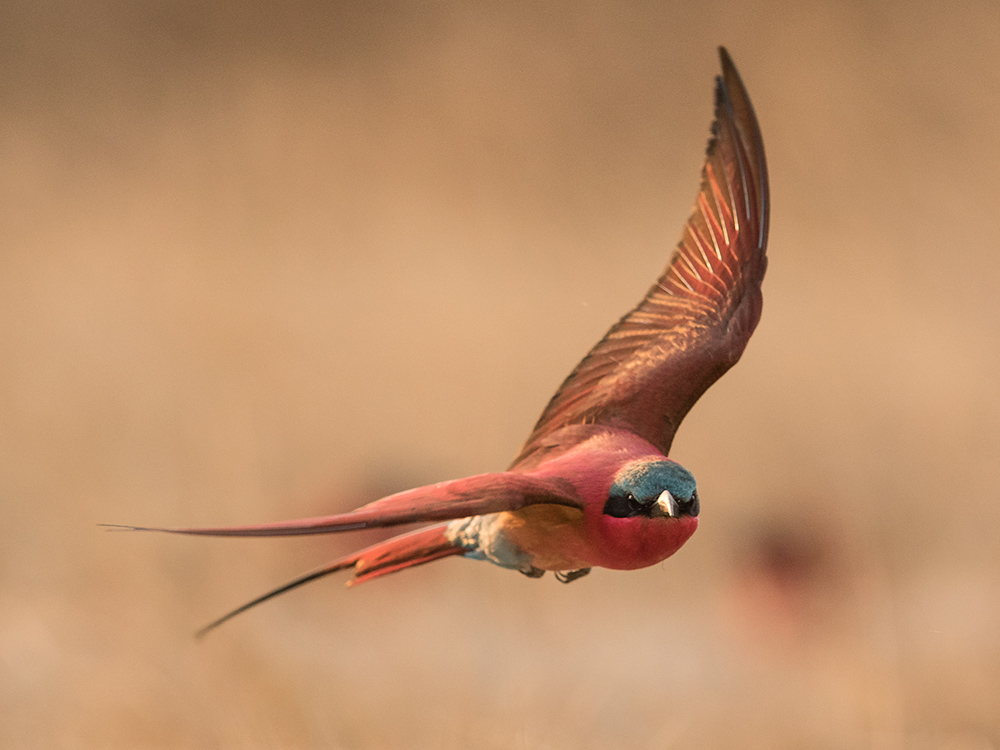
A colony of southern carmine bee-eaters on a Zambezi riverbank
Carmine bee-eaters, Aug–Nov — the Zambezi's pink-and-turquoise spectacle
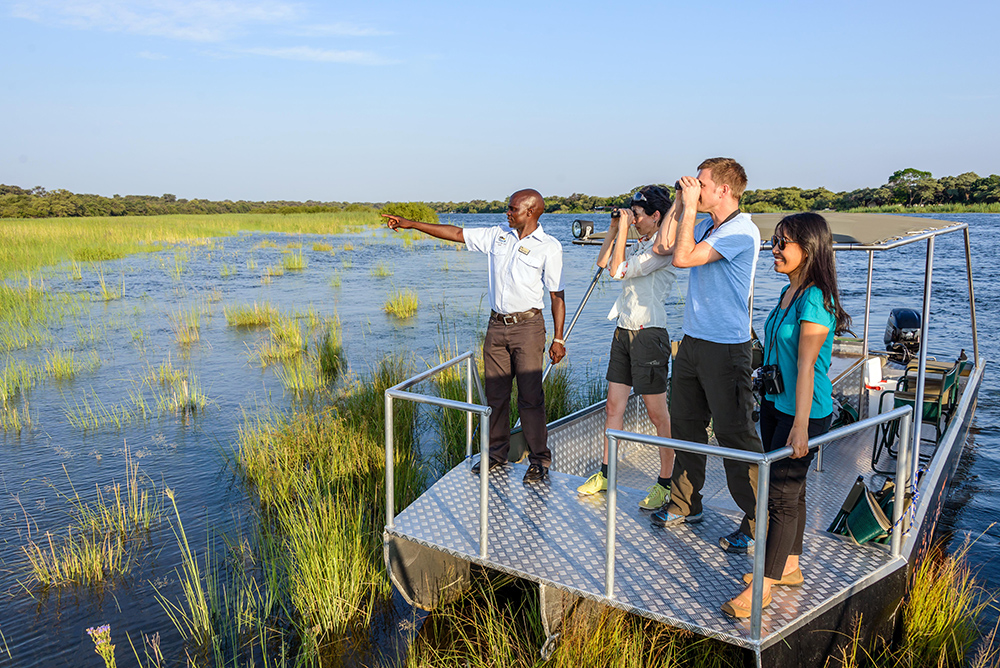
Bird spotting on the Kavango River Namibia
Boat-based birding is the Zambezi's superpower — skimmers, kingfishers and fish eagle duels

The birding calendar

When to go — the seasons, honestly

Here's where birders and general safari-goers politely part ways. The classic dry season (May–October) that suits game viewing is Namibia's birding off-peak: resident species only, many in drab non-breeding dress. The birder's prime time is November to April — the green season — when the Palaearctic and intra-African migrants pour in, residents breed in full colour and song, the Zambezi floodplains fill, and the desert itself briefly blooms with nomadic larks and coursers chasing the rain. Add dramatic skies, green backdrops for photography and lower lodge rates, and the case makes itself.

That said, the calendar has treats in every quarter: the carmine bee-eater colonies run August–November, neatly bridging the seasons; coastal wader numbers build from September; dry-season Etosha still delivers superb raptors, bustards and sandgrouse concentrating at water; and the escarpment near-endemics are resident year-round — their dawn-song window is simply louder in the rains. In exceptional wet years, Etosha's pans flood and flamingos arrive to breed in one of Africa's rarer spectacles.

Practical trade-offs of green-season birding: real heat by mid-morning (bird at dawn, siesta at noon), afternoon thunderstorms in the north, and malaria precautions for Zambezi travel — our health guide covers that properly.

The birder's calendar

  • Nov–Apr — peak: migrants in, breeding plumage, Zambezi at its richest
  • Aug–Nov — carmine bee-eater colonies on the Zambezi banks
  • Sep–Apr — coastal wader numbers at their height
  • May–Oct — residents & raptors; birds concentrate at water; combine with game viewing
  • Exceptional wet years — flamingos breed on Etosha's flooded pans
  • Any month — the near-endemics are resident; dawn is always the hour

Building a trip for both birds and big game? Shoulder months — April–May and October–November — split the difference beautifully.

Field craft, Namibia edition

How to bird Namibia well

The country hands you three advantages — open terrain, quiet roads and phenomenal light — and the technique is mostly about using them. Dawn is everything: the first two hours own the day, especially in summer heat and doubly for the escarpment endemics, several of which (Hartlaub's Spurfowl, Rockrunner) essentially perform at first light and vanish after. Build the day accordingly: bird hard early, drive or rest through the blaze, return for the golden-hour shift.

The vehicle is your hide. Namibian birds tolerate a parked car far better than a walking human — wind down, switch off, and let sandgrouse, coursers and shrikes carry on around you. In Etosha and other parks where you must stay in the vehicle anyway, waterhole-sitting is birding gold: an hour parked at a busy hole delivers a procession of doves, sandgrouse (in their thousands at dry-season peak), raptors on the hunt and everything in between. On lodge ground, walk the drainage lines and big trees — riverine growth is the bird highway of arid country.

Kit and helpers: 8x42 binoculars, a southern-African field guide or app with offline calls, notebook or listing app, sun kit and water. Use playback sparingly and never for the pressured endemics. And know when a guide pays: an Erongo local for the spurfowl and chat, a Zambezi boatman who knows his skimmer sandbars — both turn hope into ticks, and we arrange both routinely.

The field kit

  • Binoculars 8x42 — the all-terrain sweet spot
  • Field guide / app — with offline calls downloaded
  • Scope (optional) — earns its weight at the lagoon & Etosha
  • Listing app or notebook — the trip list becomes the souvenir
  • Sun kit & water — dawn starts end in desert heat
  • Neutral clothing — and patience, the free upgrade

Birding ethics, briefly

  • Playback sparingly — never on the pressured endemics
  • Nests at distance — no flushing, no lingering
  • Stay on tracks — desert crust scars for decades
  • Share sightings, not nest sites — publicly at least

Feathers in that famous light

Photographing Namibia's birds

Namibia may be the easiest place in Africa to photograph birds well: open perches, approachable subjects, clean backgrounds and light that does half the work. The workhorse setup is a zoom in the 100–400mm or 200–600mm class — big glass helps but the tolerant subjects mean it isn't the entry ticket it is elsewhere. Ride shutter speed at 1/1000s minimum for perched birds and 1/2500s+ for flight, aperture near wide open, auto-ISO absorbing the changes, and burst mode for behaviour.

The Namibian specialities to chase: rollers and bee-eaters against clean blue or storm-dark skies; the pink wall of flamingos at Walvis Bay (shoot low from the esplanade for water-level reflections); sandgrouse exploding off Etosha waterholes in golden light; a pygmy falcon posed on its weaver-nest castle; and the Zambezi's boat-level frames — skimmers slicing the river, kingfishers at eye height — which are the best bird-photography hours in the country. The vehicle-as-hide technique, beanbag on the sill, is the platform for almost all of it.

The full technique — the shutter-speed ladder, vehicle craft, ethics including why nest sites stay off social media — lives in our safari photography guide, with camera fundamentals in Photographing Namibia.

The bird shot-list

  • Flamingo masses — low angle, Walvis Bay esplanade
  • Carmine colony — wide for the wall, long for portraits
  • Roller on a perch — the fence-post gift, storm sky behind
  • Sandgrouse at water — 1/2500s+, dry-season Etosha
  • Pygmy falcon on the nest-castle — story in one frame
  • Skimmer at river level — from the Zambezi boat
  • Settings base — 1/1000s+, wide open, auto-ISO, burst

The trip, assembled

A birder's route — the classic circuit, tilted toward birds

The beauty of birding Namibia is that the birder's route is the classic route, with the dial turned. Here's a proven 14-day shape; add the Zambezi extension and it becomes the full 21-day epic ending at Victoria Falls.

14 days, tilted toward the birds
DaysBaseThe birding point
1–2Windhoek highlandsArrival + Avis Dam / Daan Viljoen for first Rockrunner and Monteiro's Hornbill
3–4Erongo mountainsThe near-endemic engine room: dawn vigils for Hartlaub's Spurfowl, Rüppell's Parrot, White-tailed Shrike
5–7Swakopmund / Walvis BayLagoon flamingos & waders, Rooibank at dawn for Dune Lark, gravel plains for Gray's Lark; Sandwich Harbour excursion
8–9Spitzkoppe / DamaralandHerero Chat country, more escarpment specials, desert light
10–12EtoshaWaterhole raptors, bustards, coursers and sandgrouse; Bare-cheeked Babbler around the eastern camps
13–14Waterberg → WindhoekCape Vulture colony and green-bushveld birding to close the list; fly out
+ ext.Zambezi (5–7 days)Mahango, river boats, carmine colonies, Pel's — then out via Victoria Falls

Green-season version (Nov–Apr) maximises the list; dry-season version trades migrants for easier game viewing and waterhole concentration. Either way, we pace the days around dawn birding — it's exactly the kind of trip we love building.

From people who stop for every roller

Our honest Namibia birding tips

  • Own the dawns — the endemics perform at first light and rarely offer encores; build every day around the first two hours
  • Trust the car — engine off, windows down; it's the best hide you'll ever drive
  • Sit at waterholes — an hour parked beats three hours driving, especially in dry-season Etosha
  • Do the Rooibank pilgrimage — the Dune Lark is the country's only "nowhere else on earth" bird; go at dawn, walk the hummocks slowly
  • Buy the Erongo guide morning — Hartlaub's Spurfowl and Herero Chat convert hope into sightings with local knowledge; money well spent
  • Get on the Zambezi water — boat birding is the region's superpower; book lodges with good boats and birding skippers (ask us which)
  • Time the carmines — Aug–Nov for the colonies; confirm active sites for your dates when booking
  • Download before you go — offline calls, offline maps; signal won't be there when the mystery lark is
  • Log your list — your sightings feed the atlas data that protects these birds; the trip list is the best souvenir anyway
  • Let the non-birders in — flamingo lagoons, bee-eater colonies and pygmy falcons convert sceptical travel partners faster than any lecture

Quick answers

Birding Namibia — FAQ

How many species could I realistically see?

Around 700 are recorded nationally. A well-routed two-week trip in green season commonly logs 250–350; add the Zambezi extension and 400+ becomes realistic for sharp-eyed birders.

Which birds are found only in Namibia?

Strictly, one: the Dune Lark of the Namib dune sea. Practically, a dozen more near-endemics shared only with remote Angola — Rockrunner, Herero Chat, Hartlaub's Spurfowl, Monteiro's Hornbill and friends — make Namibia the world's realistic place to see them.

When should a birder visit?

November–April for the full list: migrants, breeding plumage and the Zambezi at its richest. August–November catches the carmine bee-eater colonies. Dry season still birds well and pairs better with big game.

What's the single best site?

For numbers and specials, Mahango in the Zambezi Region. For spectacle, the Walvis Bay lagoon's flamingo and wader masses. For the endemics, an Erongo dawn. Happily, one trip can hold all three.

Do I need a guide?

Not for most of it — Namibia self-drives beautifully for birders. Spend on targeted help where it counts: an Erongo local for the difficult endemics, and Zambezi boat trips with birding skippers. We arrange both.

Is birding here good for beginners?

Arguably the best in Africa: open country, visible and tolerant birds, charismatic easy wins everywhere, and the car as a ready-made hide. If a trip was ever going to turn someone into a birder, it's this one.

The list is waiting

Tell us birds matter — we'll build the trip around them

Dawn-paced days, the lodges with resident bird guides and proper boats, the Rooibank morning slotted in, the Zambezi extension timed for the carmines — birding trips are craft, and they're a craft we love. One message with your dates and target list (or just "we like birds"), and a real person who stops for every roller takes it from there. No fees on top, ever.

Plan my birding trip   Back to all guides    or WhatsApp us directly

No extra fees

You pay each place's own rate — nothing on top.

Best prices

We know where the value hides in every region.

Expert advice

First-hand, from people who drive these roads.

Friendly, fast service

Real people, replies usually the same day.