Search all Namibia Accommodation


Popular places in NamibiaNamib Desert Area Etosha National Park Fish River Canyon Accommodation GuidePlaces to stay around Namibia South Namibia Central Namibia Northern Namibia Coastal Namibia |

Namibia Essential
|
Travel Guide to
|


Sesriem - Namibia
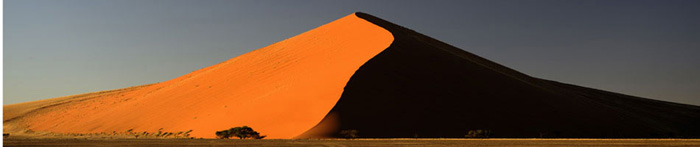
The Namib Desert is a desert in Namibia and southwest Angola that forms
part of the Namib-Naukluft National Park. The name "Namib" is
of Nama origin and means vast.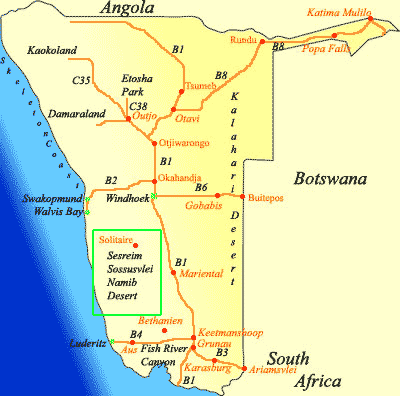
The desert occupies an area of around 80,900 km² (31,200 square miles), stretching about 1,000 miles (1,600 km) along the Atlantic Ocean coast of Namibia.
Its east-west width varies from 30 to 100 miles (50-160 km). The Namib Desert also reaches into southwest Angola.
Having endured arid or semi-arid conditions for at least 55 million years, it is considered to be the oldest desert in the world. The Namib's aridity is caused by the descent of dry air of the Hadley Cell, cooled by the cold Benguela current along the coast. It has less than 10 mm (0.4 inches) of rain annually and is almost completely barren.
A number of unusual species of plants and animals are found only in this desert. One of these is Welwitschia mirabilis, one of the most unusual species. Welwitschia is a shrub-like plant, but grows just two long strap-shaped leaves continuously throughout its lifetime. These leaves may be several meters long, gnarled and twisted from the desert winds. The taproot of the plant develops into a flat, concave disc in age. Welwitschia is notable for its survival in the extremely arid conditions in the Namib, sometimes deriving moisture from the coastal sea fogs.
A trip to this area is a remarkably surreal experience but most visitors revel in its strangeness, not to mention the feelings of stillness and quiet desert solitude that it evokes, but it is of course the world-famous Sossusvlei sand dunes that attract the most attention.
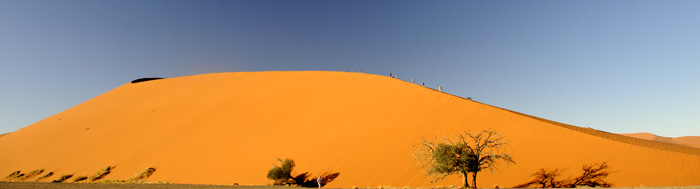
Blown into razor sharp ridges by the sand-shifting winds, the impossibly dramatic red dunes are the highest in the world, towering some 300 metres into the air, and just begging to be climbed.
Dune 45
One of the best ways to appreciate the magnificence of this area is by light aircraft on a scenic flight from Walvis Bay or Swakopmund or a balloon ride over the dunes - and there is some fantastic accommodation deep in the desert.
Although the desert is largely unpopulated and inaccessible, there are year-round settlements at Sesriem, close to the famous Sossusvlei and a huge group of sand dunes, which at more than 300 meters (984 ft) high are among the tallest sand dunes in the world. The complexity and regularity of dune patterns in its dune sea have attracted the attention of geologists for decades. They still remain poorly understood.
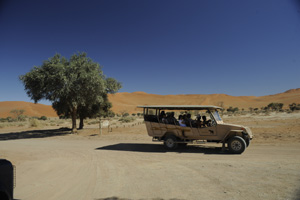
Transfers into deadvlei
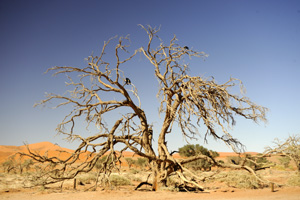
The interaction between the water-laden air coming from the sea via southerly winds, some of the strongest of any coastal desert, and the dry air of the desert causes immense fogs and strong currents, causing sailors to lose their way. Along with the Skeleton Coast further north, it is notorious as the site of many shipwrecks. Some of these wrecked ships can be found as much as 50 metres (55 yds) inland, as the desert slowly moves westwards into the sea, reclaiming land over a period of many years.
Walking the track form the 2Wd parking to Deadvlei
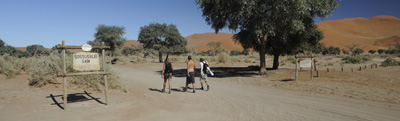
The Namib desert is an important location for the mining of tungsten, salt and diamonds. As documented in some extraordinary detail in the BBC Planet Earth (TV series) episode #5 on deserts, there is a struggle for existence in this desert by elephants, lions, oryx and other valiant survivors, a struggle that is surprising in that anything can find sustenance here at all. (A pair of oryx is seen on the Namibian coat of arms.)
Access is by light aircraft from Windhoek (the capital of Namibia, about 480 km (298 mi) north-east of the centre of the desert), Swakopmund and Walvis Bay at the north end of the desert, or overland on gravel roads.
In the Nama language, Namib means vast, quite an understatement when you're confronted with the endless orange dunes of the parched Namib desert.
Two of the types of sanddune in the Namib Desert
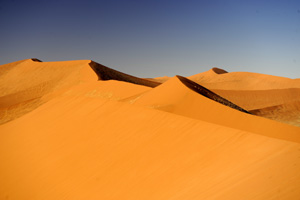
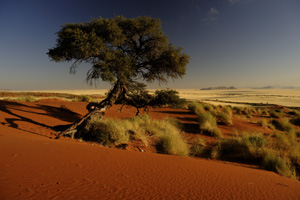
The Namib is one of the oldest and largest deserts in the world and is
protected by the Namib-Naukluft Park - a 50 000km2 wonderland of shifting
sands and colourful dunes.
The scenery may be out of this world but the Namib's wildlife and flora
are just as fascinating. Animals, insects and plants have adapted to live
in this generally inhospitable region in unique and strangely beautiful
ways.
The Sesriem Canyon, like its much bigger brother the Fish River Canyon, is invisible from even a short distance away. Closer inspection brings you to the brink of a sharp drop, but there is an easy path which takes you down into its depths. Located on the edge of the Namib Desert, the world's oldest - it is easily accessible from Windhoek or Swakopmund
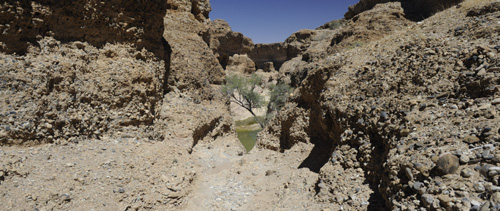
The canyon has a series of murky pools in which you can join the little fish for a dip if the water is high enough. Sesriem was an important source of water for the early inhabitants of the area, and even during dry times there is water in the upper reaches, where deep clefts in the rock reduce evaporation.
Walking through the canyon takes you on a journey back to 10-20 million years ago, when sedimentary layers of gravel and sand were deposited and cemented together by lime. The ledges are now inhabited by pigeons, raucous pied crows and chattering starlings. But look a little higher and you might see a lanner falcon or the soaring spread of a lappet faced vulture with a wingspan of 2.6m
.An amazing variety of wildlife has adapted to live in this inhospitable place, including lizards that put only 2 feet down at a time, and the black toktokkie beetle, who leans forward to run droplets of morning mist down its body and into its mouth. At night listen out for the haunting cry of the spotted eagle owl, and the far-off yowling of black-backed jackals.
Explorers, transport riders and early travellers used to lower a bucket down to collect the water. It usually took six lengths of thong tied together, hence the Afrikaans name: "Ses" meaning six, and "Riem" meaning thong. The canyon was formed by the Tsauchab River rising in the Naukluft and Zaris Mountains to the east, and flowing through to Sossusvlei.

All images copyright of Madbookings.com 2011 - Photographer Simon Wicks