
The honest comparison · Pros, cons & costs
Etosha is one of the few big parks in Africa where you can do a proper safari in your own hire car. So do you need a guide at all? Here's what each way really gives you, what it costs, and why most of our guests end up doing a bit of both.
Etosha is built for self-drivers. The roads are graded gravel, the waterholes are signposted, and the park is so dry that the animals come to you. A normal hire car, a map and some patience will show you elephant, giraffe, zebra, springbok and very often lion and rhino.
A guide doesn't replace that — it adds to it. You get a higher seat in an open vehicle, a trained pair of eyes, a radio network that knows where the lions were an hour ago, and the one thing no self-driver can have: time in the park after dark.
Our usual advice: self-drive for the freedom, then book one guided morning drive early in your stay to learn the park, and one night drive for the animals you'll never see in daylight.
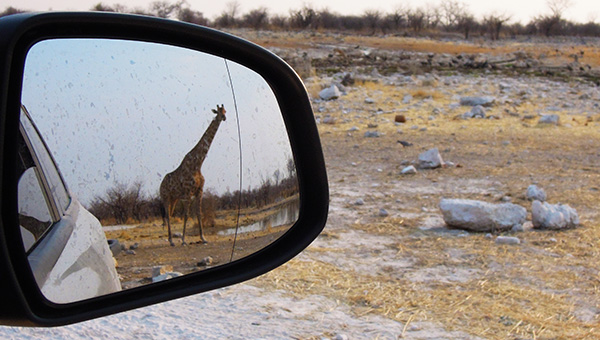
You drive in through one of the four gates, pay the park fee at the gate or at your camp, and from then on the park is yours from sunrise to sunset. Most people plan a loop from waterhole to waterhole, park up where something is happening, and head back to camp for lunch and a swim in the midday heat.
Full road, gate and route advice is in our Etosha visitor guide and self-drive planning guide.
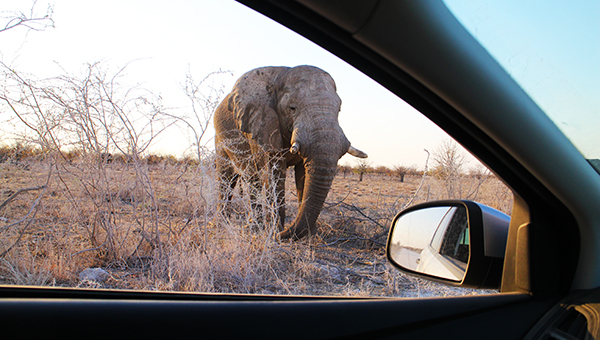
Self-driving is how most visitors see Etosha, and for good reason. It isn't perfect, though, and it helps to know where it falls short before you rely on it for your whole stay.
Approximate eye heights — in Etosha, height matters more than four-wheel drive
A guided drive puts you in an open-sided safari vehicle with tiered seats and a trained guide at the wheel. There's no fixed route: guides follow the latest sightings and share them with each other by radio. There are three ways to do it.
Okaukuejo, Halali and Namutoni run morning, afternoon and night drives of about two to three hours. Book at reception when you arrive, or ask us to book ahead in busy months. At the last published rates, a day drive is about N$650 and a night drive about N$750 per person, paid at reception.
Most lodges near the Andersson and Von Lindequist gates run their own vehicles into the park, usually with drinks and snacks, smaller groups and more comfortable seating. Expect about N$990–1,550+ per person. Ask whether the park fee is included — it often isn't.
Several lodges sit on private reserves bordering Etosha, such as Onguma and Ongava. They can drive their own land at night, sometimes with rhino tracking or walks — experiences the national park itself doesn't allow.

A good guide can turn a quiet morning into the best sighting of your trip. But you pay per person, per drive, and you hand over control of where you go and how long you stay.
Where one way clearly comes out ahead, it's marked with a tick. Several rows are a genuine draw — it depends on what matters to you.
| Self-drive | Guided drive | |
|---|---|---|
| Cost | Park fee + your hire car, however many people | Per person, per drive, on top of the park fee |
| Freedom | Your route, your timing, all day | Set departure times, 2–3 hours, shared decisions |
| Spotting wildlife | Your eyes, the sightings book and luck | Trained guide plus a radio network |
| Viewing height | Sedan ±1.1 m · SUV ±1.5 m | Open tiered seating ±2.3 m |
| Photography | Stay as long as the light is good; window frames limit angles | Clear angles all round; less time to wait for the moment |
| After dark | Not allowed — in camp by sunset | Night drives from the NWR camps |
| Learning | Your field guide and the camp information boards | Behaviour, tracks and conservation explained |
| Comfort | Closed, air-conditioned, but you do the driving | Open to cold mornings, sun and dust — but you just look |
| Young children | Your pace, your breaks, snacks on demand | Fixed times; under-6s at the camp's discretion |
| Privacy | Just your group | Shared, unless you book a private vehicle |
Swipe sideways on a phone to see the full table.
Here's a worked example for two foreign adults spending two days in the park and staying at an NWR camp. Accommodation and car hire are left out, because you pay those either way.
| Park fee · 2 adults × 2 days × N$280 | N$1,120 |
|---|---|
| Vehicle fee · 2 days (small daily charge) | ± N$120 |
| Total | ± N$1,240 |
| Park and vehicle fees, as above | ± N$1,240 |
|---|---|
| Morning drive · 2 × ±N$650 | ± N$1,300 |
| Night drive · 2 × ±N$750 | ± N$1,500 |
| Total | ± N$4,040 |
The park fee is the same whichever way you explore — guided drives are an extra on top, not an alternative to it. Park fees rose on 1 April 2026: foreign adults now pay N$280 per day (SADC adults N$180, Namibians N$60), charged per 24 hours from when you enter.
Guided drive prices are NWR's last published rates and can change, so treat them as a guide and confirm at reception or with us. The same two drives from a private lodge would cost roughly N$4,000–6,200 for two, usually with drinks and snacks included.
For families the gap grows fast: four people on two guided drives pay for eight seats, while a self-drive car costs the same however many are in it.
For tipping and money tips, see our money and costs guide.
This three-day route crosses the park from south to east, staying at NWR camps. It uses guides where they add the most — early on, to learn, and after dark — and self-drives everything else. The waterholes named here are covered in our game drives guide.
Day 1 · Andersson Gate → Okaukuejo
Day 2 · Okaukuejo → Halali
Day 3 · Halali → Namutoni → out
Find yourself below. Most travellers fit more than one, which is usually a sign to mix both.
Everything is new, and a guide helps you make sense of it. Start with a guided morning drive, then self-drive with confidence.
Both — guided first
Short attention spans, snack stops and pool breaks matter more than expert commentary. A night drive can be a highlight for older children.
Mainly self-drive
You need time at a waterhole for the light and the moment, which favours your own car. Add a guided drive for the height and open angles.
Self-drive, plus a guided drive
The park fee is unavoidable, but drive fees aren't. Etosha rewards patient self-drivers more than almost any park in Africa.
Self-drive
Etosha's roads are easy by Namibian standards, but if driving would spoil the trip, base yourself at a lodge and let them do it.
Guided
You want the nocturnal species, the behaviour and the stories. Self-drive in the day and add every night drive you can.
Both — with night drives
If you're self-driving
If you're on a guided drive
For most visitors, both. Self-driving gives you freedom and the lowest cost, and Etosha is one of the easiest parks in Africa to explore in your own car. A guided drive adds height, expert spotting and a radio network — and it's the only way to be in the park after dark.
Yes, if you follow the park rules: stay in your vehicle except in camps and fenced rest stops, keep to the roads, respect the 60 km/h limit and be inside a camp or out of the gate by sunset. The roads are graded gravel and a normal car copes.
No. Self-drivers may only be on the park roads between sunrise and sunset. Night drives inside Etosha are run only by NWR from its camps inside the park; some private reserves next to the park also run night drives on their own land.
No. The main roads are graded gravel and a sedan manages fine. A higher vehicle such as an SUV or bakkie is the real upgrade, because it lets you see over the grass.
Usually, but NWR leaves participation of children under six to the camp's discretion, and private lodges set their own minimum ages. Check when you book. With young children, self-driving is often the easier option.
Since 1 April 2026, foreign adults pay N$280 per day, SADC adults N$180 and Namibians N$60, plus a small daily vehicle fee. It's charged per 24 hours from when you enter and applies whether you self-drive or take guided drives.
Section 12 · Tick it off
Gates open at sunrise and close at sunset for everyone. Plan your self-drive afternoons backwards from closing time.
Rather have it all arranged?
Tell us your dates and how you like to travel. A real person who knows Etosha will put together the right mix — the camps, a higher hire car, and guided drives booked where they count — at the properties' own rates, with no booking fee.
You pay each place's own rate — nothing on top.
We know where the value hides around every gate.
First-hand, from people who drive these waterholes.
Real people, replies usually the same day.