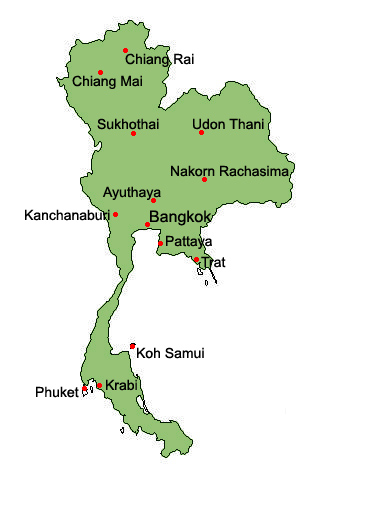
Map and information about Lopburi
 Excavations in Lop Buri have revealed that the city was clearly a site
of strategic significance, with evidence that the city has been inhabited
for over 1,200 years. In fact, relics from as early as the Bronze Age
chronicle a history that has seen Lop Buri develop into intriguing city
with a blend of both eastern & western influences featuring both ancient
and modern attractions.Lop Buri was first developed into a major town
during the era of the Dvaravati Kingdom (6th-11th centuries) when Indian
culture was influential to the region. However, most historians believed
the first settlers of the town were the Lawa (an ethnic group related
to the Mons), which may be the reason for naming the town La-Wo. Around
the 10th century the town came under the sovereignty of the Khmers and
it became one of their outlying provincial capitals, although some have
argued that La-Wo was the capital of an empire that ruled for many centuries
until relocating its seat of power to Ayutthaya in the late 11th century.
Regardless, Khmer Mahayana Buddhism was a major influence on the town’s
architecture, a style that has since been commonly referred to as Lop
Buri Style. Remains of Khmer-Hindu architectural motifs found in the city
include the Shiva’s Shrine (Prang Khaek), San Phra Kan, Phra Prang
Sam Yot, and Wat Phra Si Maha Tat.In the late 13th century the Thais,
who migrated from the North, fought against the Khmers and declared their
independence. Since then, Lop Buri has been ruled by Thai Kings. In 1664,
King Narai, a King of Ayutthaya, made Lop Buri the second capital with
the help of French architects. Therefore, the architectural style of Lop
Buri during the reign of King Narai was half Thai and half western and
is best appreciated at his Royal Palace and the Royal Reception House.
Excavations in Lop Buri have revealed that the city was clearly a site
of strategic significance, with evidence that the city has been inhabited
for over 1,200 years. In fact, relics from as early as the Bronze Age
chronicle a history that has seen Lop Buri develop into intriguing city
with a blend of both eastern & western influences featuring both ancient
and modern attractions.Lop Buri was first developed into a major town
during the era of the Dvaravati Kingdom (6th-11th centuries) when Indian
culture was influential to the region. However, most historians believed
the first settlers of the town were the Lawa (an ethnic group related
to the Mons), which may be the reason for naming the town La-Wo. Around
the 10th century the town came under the sovereignty of the Khmers and
it became one of their outlying provincial capitals, although some have
argued that La-Wo was the capital of an empire that ruled for many centuries
until relocating its seat of power to Ayutthaya in the late 11th century.
Regardless, Khmer Mahayana Buddhism was a major influence on the town’s
architecture, a style that has since been commonly referred to as Lop
Buri Style. Remains of Khmer-Hindu architectural motifs found in the city
include the Shiva’s Shrine (Prang Khaek), San Phra Kan, Phra Prang
Sam Yot, and Wat Phra Si Maha Tat.In the late 13th century the Thais,
who migrated from the North, fought against the Khmers and declared their
independence. Since then, Lop Buri has been ruled by Thai Kings. In 1664,
King Narai, a King of Ayutthaya, made Lop Buri the second capital with
the help of French architects. Therefore, the architectural style of Lop
Buri during the reign of King Narai was half Thai and half western and
is best appreciated at his Royal Palace and the Royal Reception House.
The fascinating city of Lop Buri is a unique blend of East and West, ancient
and modern, royal splendor and majestic ruins, all of which offer tantalizing
glimpses into the city’s alluring history. Located 155 kilometers
north of Bangkok, Lop Buri is unlike many historical cities. Modern day
Lop Buri has grown up and, for the most part, enveloped the remains of
the old city, which had been a settled by various groups over the centuries.
In recent years, Lop Buri was discovered by tourists who were interested
in history and culture, and the city now offers a refreshing insight into
Thailand's history. Visitors arriving by road might be somewhat surprised
to be greeted by a giant pink wedding cake ‘kratong’ that
sits brashly in the middle of a pond at the town’s main roundabout.
However, those arriving by rail are given a sneak preview of the history
awaiting them in the shape of Wat Phra Sri Ratana Maha Tat, the 12th century
ruins of a Khmer temple complex that lies close to the rustic, little
railway station. The temple has several important prangs, parts of which
date back to the 10th and 11th centuries and attest to the influence of
the Angkorian Khmers in the region. The town is also overrun with monkeys,
most of which take up residence around the ruins where they are honored
each year with an enormous feast.
Key Tips
Beware of valuables, including ear-rings and cameras, as the monkeys of
Lop Buri are known to steal anything they can get their hands on.The Lop
Buri train station has baggage storage if you wish to stop for a few hours
and walk to the nearby attractions.