Namibia activity guide · 2027 edition · free & printable
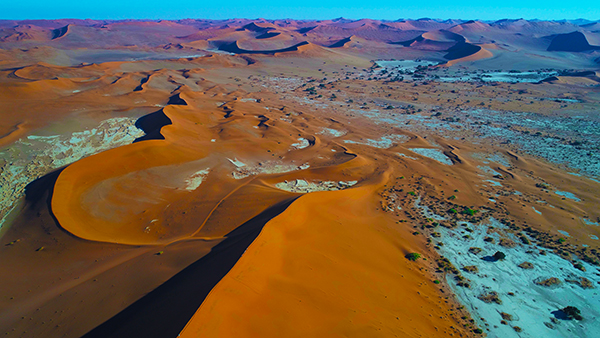
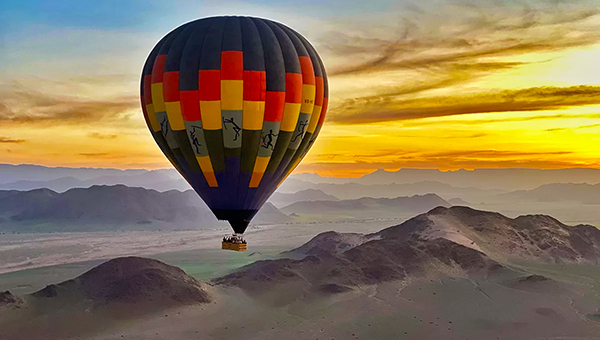
There is one way to understand the true scale of the world's oldest desert, and it launches an hour before sunrise. Drifting over the dune sea in a hot air balloon — sometimes brushing the ridgelines, sometimes half a mile up — you watch the first light set the sand on fire while oryx cast hundred-metre shadows below. Then you land, and there's a champagne breakfast waiting in the middle of nowhere. This guide covers the whole experience: how the morning unfolds, the operator behind it, who can fly, what it costs and why, and how to photograph a flight you'll never forget.
The desert's other dimension
From the ground, the Namib overwhelms you with height — dunes like mountains, horizons that swallow the road. From a balloon, it reveals something the ground never can: pattern. The dune sea resolves into ordered waves rolling to the Atlantic. The mysterious fairy circles of the NamibRand stretch out in their thousands like a message written on the plains. Dry rivers braid silver through the red. And because a balloon travels with the wind, all of it happens in near-total silence — broken only by the occasional dragon-breath of the burner and, if you're lucky, the far-off bark of a jackal.
The timing multiplies everything. Every flight launches at sunrise, when the desert's air is calmest and its light is at its most extraordinary — long shadows raking off every ridge, the sand shifting from mauve to ember to gold in the space of your flight. Wildlife works this hour too: oryx, springbok and ostrich move across the plains below, trailing shadows many times their own length.
It's routinely described by our clients as the single best thing they did in Namibia — honeymooners, photographers and hardened safari veterans alike. If your trip includes Sossusvlei and the budget can stretch to one big splurge, this is the one we recommend without hesitation.
Hour by hour
A balloon safari is a whole desert morning, not just a flight. Here's the honest timeline, so you know exactly what you're signing up for — including the early alarm that everyone forgets to mention and nobody regrets.
| When | What happens |
|---|---|
| ±1 hr before sunrise | Meet at the balloon office near Sesriem (exact time confirmed the day before). Coffee, briefing, and a short drive to the launch site the pilot has chosen for the morning's wind. |
| Pre-dawn | The inflation — a spectacle in itself: fans roar, the burner throws firelight into the envelope, and a building-sized balloon rises out of the dark desert floor. |
| Sunrise | Launch. The balloon lifts as the sun breaks the horizon — the desert's calmest air and greatest light, at once. |
| ±1 hour aloft | Drift with the wind anywhere from 600 to 3,000 feet — sometimes skimming low over ridges and plains, sometimes high enough to see the dune sea entire. The pilot steers by finding different winds at different altitudes. |
| Landing | Most landings settle gently onto the trailer; in fresher ground winds you may get a "sports landing" — a tip-and-drag finish that becomes everyone's favourite story at breakfast. |
| Mid-morning | The signature desert breakfast at the landing site — a properly celebratory spread in the open wilderness, sparkling-wine toast included, with your pilot telling flying stories. Flight certificate presented. |
| 10:00–11:00 | A scenic nature drive returns you to the meeting point — in time to continue to Sossusvlei, or even begin the drive to your next destination. |
Launch sites vary with the wind — the main areas are the Kulala Wilderness Reserve between Sesriem and Sossusvlei, and the northern NamibRand Nature Reserve. Where exactly you fly and land is decided by the morning itself; that's rather the point of ballooning.
Who's flying you
Ballooning at Sossusvlei means flying with Namib Sky Balloon Safaris — a genuine Namibian institution. Founded in 1991 by Eric and Nancy Hesemans and now run by the second generation, Denis and Andreia, they've carried well over 100,000 passengers across three decades with a 100% safety record. This is fully licensed commercial aviation, not a sideline: NCAA-issued air service licence and Air Operating Certificate, commercially licensed pilots, professional ground crew, and equipment certified and maintained to international standards. Flights operate over some of Namibia's most protected land — the Kulala Wilderness Reserve and the NamibRand — with the concession and park fees built into the rate.
Two things about them we particularly like telling clients. First, the operation walks its environmental talk: retrieval vehicles keep to existing tracks only, every trace of each landing and breakfast is removed, and the balloon base runs entirely on solar power — where they also grow fresh produce for that desert breakfast. Second, the community work is real: the Namib Sky Community Trust founded the region's first lower primary school and early-childhood development centre, educating the children of the remote desert community their staff call home. Your splurge morning quietly funds both.
Baskets are oversized and passenger numbers deliberately limited — the largest balloons take 18 people. Private-basket flights for special occasions can be arranged on request; ask us.


The calendar and the wind
Flights run at sunrise virtually year-round, with one honest exception: the operation closes from 15 January to 15 February — the desert's hottest weeks — plus Christmas Day and New Year's Day. Within the season, the dry winter months (May–September) offer the most reliably stable mornings, but the Namib's dawn air is famously calm in most months; this is one of the world's great ballooning locations precisely because its mornings behave.
That said, every flight is weather permitting, and the pilot's word is final. Ballooning needs dry air, good visibility and light, consistent wind — and if the morning doesn't deliver, the flight is cancelled with the flight cost fully refunded (a transfer fee, if you booked one, remains payable). Cancellations are the exception here, not the rule, but they happen — which leads to the single most useful planning tip in this guide: schedule the balloon for the first morning of your Sossusvlei stay, not the last. If weather intervenes, you have the option of trying again the next dawn instead of driving away wondering.
Booking-wise: reserve well ahead in high season (July–October books out), and reconfirm your exact meeting time with the operator the day before you fly — it shifts with sunrise through the year.
Pairing tip: the night before your flight is a Sossusvlei night anyway — make it a double feature with our stargazing guide. Dark sky at night, dune sea at dawn.
The fine print, made friendly
Getting there: the meeting point is the balloon office in the Sesriem/Sossusvlei area, about an hour before sunrise — most guests simply self-drive the short hop from their lodge (headlights on, wildlife eyes open). Transfers from selected nearby lodges can be arranged at extra cost, subject to availability; tell us where you're staying and we'll sort the logistics when we book.
In the air: flights ride anywhere between roughly 600 and 3,000 feet — the pilot climbs and descends to catch different wind directions at different altitudes, which is how a "steerless" aircraft is steered. You stand for the flight in a divided, oversized basket; no experience, no head for heights and no fitness beyond climbing into the basket is required. It is, genuinely, the gentlest hour in aviation.
Paying: if we've booked it for you, you simply bring your voucher. Booking direct, card details secure the reservation but payment is processed after the flight — a traveller-friendly policy that means an on-site weather cancellation costs you nothing in bank fees. On the day, cash in NAD, ZAR, USD or EUR and most cards work; American Express doesn't.
Almost everyone — with three exceptions
The beauty of ballooning is its gentleness — no G-forces, no exertion, no experience needed — so the passenger rules are short. Children fly from 120 cm tall or 6 years old, the height needed to see over the basket rim (and note that children pay full adult price: insurance and space rules mean every body on board occupies a full slot). Smaller children aren't left out of the morning — they can chase the balloon with the ground crew in the retrieval 4x4, waving up at the family, and everyone reunites at the desert breakfast. Babysitting can even be pre-arranged free of charge.
Pregnancy is the firm no: insurance cover doesn't extend to expectant mothers, however smooth the flight. And mobility deserves honest words: you'll need to climb into a chest-high basket (step assistance and all the crew's help provided), stand for around an hour, and be able to adopt the braced landing position the pilot demonstrates. If anyone in your party has back, hip or mobility concerns, tell us when booking — we'll check the specifics with the operator rather than guess.
Beyond that: fear of heights surprises people here. The basket's solid walls and the balloon's total steadiness mean even confirmed acrophobes routinely report feeling completely secure — there's no edge-of-the-cliff sensation, just the world calmly rearranging itself below.
Dress for two temperatures
Here's the counterintuitive truth about balloon mornings: the coldest part happens on the ground. The pre-dawn wait between your lodge and launch is genuinely chilly — near freezing in winter — but once airborne, the burner's heat and the fact that you travel with the wind (so feel none of it) keep the basket surprisingly comfortable, and the desert warms rapidly after sunrise. So: layers. A warm jacket over a fleece over a shirt, sheddable as the morning heats, with a beanie and gloves earning their keep from June to August.
On your feet, closed shoes — you'll cross sandy, uneven ground at launch and landing, and the landing itself occasionally involves a braced, tipped-basket finish where sandals have no place. Add a cap and sunglasses for the post-sunrise glare and the burner overhead, and sunscreen for the breakfast that follows.
Bring the camera (next section) and as little else as possible — the basket is no place for loose, droppable items, and anything that goes over the side is gone into a protected reserve. Phones on lanyards or zipped pockets; hats snug.
The flight your camera dreams about
A balloon over the Namib at sunrise is arguably the best hour of photography Namibia offers, and it rewards a little preparation. The golden rules: strap everything (camera on a neck strap, phone in a zipped pocket or on a lanyard — nothing gets retrieved from a nature reserve), spare battery in a warm pocket, and shoot far more than feels reasonable — the light changes by the minute and never repeats.
Settings: the basket is stable but the light is low early on, so start around 1/250s minimum, aperture middling (f/5.6–f/8 once the sun is up), auto-ISO doing the work. A medium zoom (24–105mm or similar) covers 90% of the flight — wide for the dune sea and the balloon's own envelope, longer for oryx and their shadows below. Shoot RAW for the extreme dawn contrast.
The shots to plan for: the firelit inflation in the pre-dawn dark (high ISO, embrace the drama); the moment of sunrise over the dune sea; your balloon's shadow rippling across the sand; other balloons in the golden air if several fly; the abstract dune patterns straight down; wildlife trailing long shadows; and the breakfast table absurdly, wonderfully alone in the wilderness. Videographers: the burner blasts are your sound design — capture clean audio of one, and the silence between them.
Full camera technique lives in our Photographing Namibia guide; if you're filming, the shot-list discipline in Filming Namibia applies perfectly to a balloon morning. Note that this is one activity where your drone stays packed — you're flying over protected reserves under aviation rules.
The honest money talk
Let's say it plainly: a balloon safari is a premium activity — for most travellers the single most expensive few hours of a Namibia trip — and it's worth understanding why before deciding it's worth it (our clients overwhelmingly conclude it is). The rate buys a fully licensed aviation operation in one of the remotest protected areas on earth: commercially licensed pilots, a professional ground and retrieval crew, certified equipment under continuous maintenance, and the concession and park fees for flying over national park and reserve land — all included, along with the signature desert breakfast and its logistics. Passenger numbers are deliberately kept low; you are not being packed in.
A few cost realities worth knowing: children pay full price (every person aboard occupies a full insured space); private baskets for proposals, anniversaries and small groups can be arranged on enquiry; and the operator's charge-after-you-fly payment policy means a weather cancellation genuinely costs you nothing but the alarm clock. We don't publish a price here because rates change seasonally — we quote the current rate the day you enquire, and as always, booking through us costs nothing extra.
Budgeting advice from experience: if the trip allows one big splurge, make it this one, and offset it elsewhere — a camping night, a self-catered dinner. The full picture of where a Namibia budget goes is in our money & costs guide.
From people who've stood in that basket
Quick answers
About an hour in the air, at anywhere from 600 to 3,000 feet — within a 3.5–4 hour morning that includes the pre-dawn meeting, inflation, flight, desert breakfast and nature drive back by 10–11am.
Ballooning is the gentlest form of aviation, and the Sossusvlei operator has flown 100,000+ passengers over three decades with a 100% record, commercial pilots and full NCAA licensing. Flights simply don't launch in unsuitable weather.
At sunrise, virtually year-round, weather permitting — closed 15 January to 15 February plus Christmas Day and New Year's Day. Book well ahead for July–October.
From 120 cm or age 6 they fly (at full price — insurance space rules). Smaller ones follow with the ground crew in the 4x4 and rejoin at breakfast; free babysitting can be pre-booked.
Full refund of the flight cost (transfer fees excluded), thanks to the pay-after-you-fly policy. If your itinerary allows, ask immediately about flying the next morning — and schedule the balloon early in your stay to keep that option open.
Layers and closed shoes. The wait before launch is the cold part — near freezing in winter — but the burner and moving with the wind keep the flight comfortable, and the desert warms fast after sunrise.
Licensed aviation in a remote protected area: commercial pilots, ground crew, certified equipment, and concession plus park fees for the reserves you fly over — all in the rate, with the desert breakfast on top. We quote current rates when you enquire; booking through us adds nothing.
The dawn is booked solid — don't wait
We'll check availability, quote the current rate, match your Sossusvlei lodge to the pre-dawn meeting point, schedule the flight early in your stay for a weather buffer, and slot the whole morning into your route — dunes still ahead of you by 11am. One message starts it, and booking through us never costs extra.
Book my balloon morning Back to all guides or WhatsApp us directly
You pay each place's own rate — nothing on top.
We know where the value hides in every region.
First-hand, from people who drive these roads.
Real people, replies usually the same day.